what are the elements that must be present for a crime to have occurred
four.1 Criminal Elements
Learning Objectives
- List the elements of a law-breaking.
- Define the criminal act element.
- Identify three requirements of criminal act.
- Describe an exception to the criminal deed element.
- Ascertain iii situations where an omission to act could be criminal.
- Distinguish between actual and effective possession.
- Identify the criminal intent element required when possession is the criminal human action.
Crimes tin be broken down into elements, which the prosecution must prove across a reasonable doubt. Criminal elements are set forth in criminal statutes, or cases in jurisdictions that allow for common-constabulary crimes. With exceptions, every crime has at least three elements: a criminal act, too called actus reus; a criminal intent, too called mens rea; and concurrence of the 2. The term conduct is often used to reflect the criminal deed and intent elements. Every bit the Model Penal Code explains, "'bear' means an action or omission and its accompanying state of listen" (Model Penal Code § 1.13(5)).
Figure 4.1 Criminal Code of Georgia

Recall from Chapter 1 "Introduction to Criminal Law" that not all crimes require a bad event. If a criminal offense does require a bad result, the prosecution must also prove the additional elements of causation and impairment.
Another requirement of some crimes is bellboy circumstances. Attendant circumstances are specified factors that must be present when the criminal offence is committed. These could include the crime'due south methodology, location or setting, and victim characteristics, among others.
This chapter analyzes the elements of every crime. Chapter 7 "Parties to Criminal offense" through Affiliate thirteen "Crimes against the Government" analyze the elements of specific crimes, using a general overview of most states' laws, the Model Penal Code, and federal law when advisable.
Example of a Crime That Has Only 3 Elements
Janine gets into a fight with her swain Conrad after the senior prom. She grabs Conrad's machine keys out of his paw, jumps into his automobile, and locks all the doors. When Conrad strides over to the car, she starts the engine, puts the car into drive, and tries to run him down. Information technology is dark and difficult for Janine to see, so Conrad easily gets out of her fashion and is unharmed. However, Janine is thereafter arrested and charged with attempted murder. In this instance, the prosecution has to bear witness the elements of criminal human action, criminal intent, and concurrence for attempted murder. The prosecution does not accept to prove causation or that Conrad was harmed because attempt crimes, including attempted murder, do not have a bad issue requirement. Attempt and other incomplete or inchoate crimes are discussed in Chapter 8 "Inchoate Offenses".
Criminal Human activity
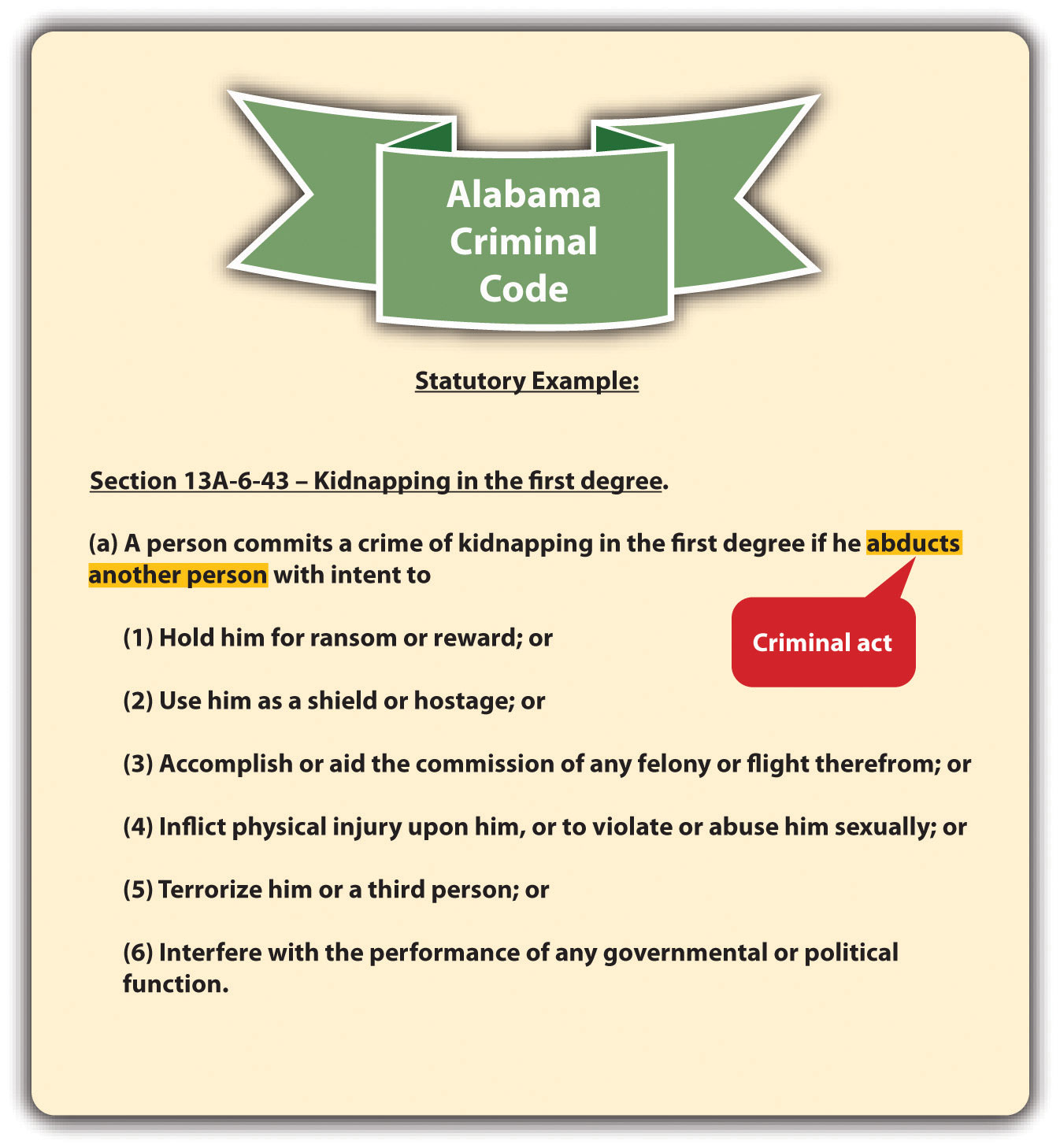
Criminal act, or actus reus, is mostly defined equally an unlawful actual motility (N.Y. Penal Constabulary, 2010). The criminal statute, or case in jurisdictions that allow common-police force crimes, describes the criminal act element.
Figure 4.2 Alabama Criminal Code
The Requirement of Voluntariness
One requirement of criminal human activity is that the defendant perform it voluntarily. In other words, the defendant must command the act. Information technology would not serve the policy of specific deterrence to punish the defendant for irrepressible acts. The Model Penal Code gives the post-obit examples of acts that are not voluntary and, therefore, not criminal: reflexes, convulsions, actual movements during unconsciousness or slumber, conduct during hypnosis or resulting from hypnotic proffer, or a bodily movement that otherwise is non a production of the effort or determination of the actor, either witting or habitual (Model Penal Code § two.01 (two)). I voluntary act is enough to fulfill the voluntary act requirement. Thus if a voluntary act is followed by an involuntary one, the courtroom may still impose criminal liability depending on the circumstances (Govt. of Virgin Islands v. Smith, 2010).
Example of an Involuntary and Noncriminal Act
Perry is hypnotized at the local canton fair. The hypnotist directs Perry to smash a banana cream pie into his girlfriend Shelley's confront. Cracking a pie into a person'southward face is probably battery in virtually states, but Perry did not commit the act voluntarily, so he should non be bedevilled of a criminal offense. Punishing Perry for bombardment would non specifically deter Perry from performing the act once more while hypnotized because he is not in command of his behavior when experiencing this mental country.
Example of a Voluntary Act Followed by a Nonvoluntary Deed
Timothy attends a party at a friend'due south house and consumes several glasses of ruby wine. Timothy and so attempts to drive his vehicle home. While driving, Timothy passes out at the bike and hits some other vehicle, killing its occupant. Timothy tin probably be convicted of one or more crimes in this situation. Timothy'south acts of drinking several glasses of wine and then driving a vehicle are voluntary. Thus fifty-fifty though Timothy got into a car blow while unconscious, his involuntary act was preceded by conscious, controllable, and voluntary action. A penalisation in this instance could specifically deter Timothy from drinking and driving on another occasion and is appropriate based on the circumstances.
Status as a Criminal Act
By and large, a accused'southward status in society is not a criminal act. Status is who the defendant is, not what the defendant does. Similar to penalty for an involuntary human activity, when the government punishes an private for status, it is essentially targeting that individual for circumstances that are exterior his or her control. This penalty may be roughshod and unusual pursuant to the Eighth Amendment if it is disproportionate to the defendant's behavior.
In Robinson v. California, 370 U.S. 660 (1962), the Us Supreme Court held that it is unconstitutional as brutal and unusual punishment pursuant to the Eighth Amendment to punish an individual for the status of being a drug addict—even if the drugs to which the defendant is addicted are illegal. The Court compared drug addiction to an illness, such as leprosy or crabs illness. Punishing a accused for being sick not simply is inhumane only besides does not specifically deter, like to a punishment for an involuntary act.
If the defendant can command the deportment at upshot in spite of his or her status, the defendant's deport can be constitutionally criminalized and punished pursuant to the 8th Amendment. In Powell 5. Texas, 392 U.Due south. 514 (1968), the United states Supreme Court upheld the defendant's conviction for "boozer in public," in spite of the defendant's status as an alcoholic. The Court held that it is difficult but non impossible for an alcoholic to resist the urge to drink, and then the behavior the statute criminalized was voluntary. Also, the Court ruled that the state has an involvement in treating alcoholism and preventing alcohol-related crimes that could hurt the defendant and others. Pursuant to Powell, statutes that criminalize voluntary acts that arise from status are constitutional under the Eighth Amendment.
Example of a Constitutional Statute Related to Status
Refer to the example in Section 4 "Example of a Voluntary Act Followed by a Nonvoluntary Act", where Timothy drives under the influence of booze and kills another. A land statute that criminalizes killing another person while driving under the influence is constitutional as applied to Timothy, even if Timothy is an alcoholic. The state has an interest in treating alcoholism and preventing alcohol-related crimes that could hurt or kill Timothy or some other person. Timothy's human action of driving while intoxicated is voluntary, fifty-fifty if his status as an alcoholic makes it more hard for Timothy to control his drinking. Thus Timothy and other alcoholic defendants tin be prosecuted and punished for killing another person while driving under the influence without violating the Eighth Amendment.
Thoughts as Criminal Acts
Thoughts are a part of criminal intent, non criminal act. Thoughts cannot exist criminalized.
Example of Noncriminal Thoughts
Brianna, a housecleaner, fantasizes near killing her elderly customer Phoebe and stealing all her jewelry. Brianna writes her thoughts in a diary, documenting how she intends to rig the gas line and so that gas is pumped into the business firm all night while Phoebe is sleeping. Brianna includes the date that she wants to kill Phoebe in her almost recent diary entry. As Brianna leaves Phoebe's house, her diary accidentally falls out of her purse. Later, Phoebe finds the diary on the floor and reads it. Phoebe calls the police force, gives them Brianna's diary, and insists they arrest Brianna for attempted murder. Although Brianna's murder plot is sinister and is documented in her diary, an abort is improper in this example. Brianna cannot be punished for her thoughts solitary. If Brianna took substantial steps toward killing Phoebe, an attempted murder charge might be appropriate. Nonetheless, at this stage, Brianna is just planning a crime, non committing a offense. Phoebe may exist able to go to court and get a restraining order against Brianna to prevent her from carrying out her murder plot, but Brianna cannot be incapacitated by arrest and prosecution for attempted murder in this case.
Omission to Deed
An exception to the requirement of a criminal act element is omission to act. Criminal prosecution for a failure to human action is rare because the government is reluctant to compel individuals to put themselves in damage's style. However, under certain specific circumstances, omission to act can be criminalized.
An omission to deed tin can just be criminal when the law imposes a duty to human activity (Due north.Y. Penal Law, 2010). This legal duty to act becomes an element of the offense, and the prosecution must bear witness it across a reasonable doubt, along with proving the defendant'southward inaction under the circumstances. Failure or omission to act is merely criminal in three situations: (1) when there is a statute that creates a legal duty to human activity, (ii) when there is a contract that creates a legal duty to human action, or (3) when in that location is a special human relationship between the parties that creates a legal duty to human activity. Legal duties to deed vary from state to country and from state to federal.
Duty to Act Based on a Statute
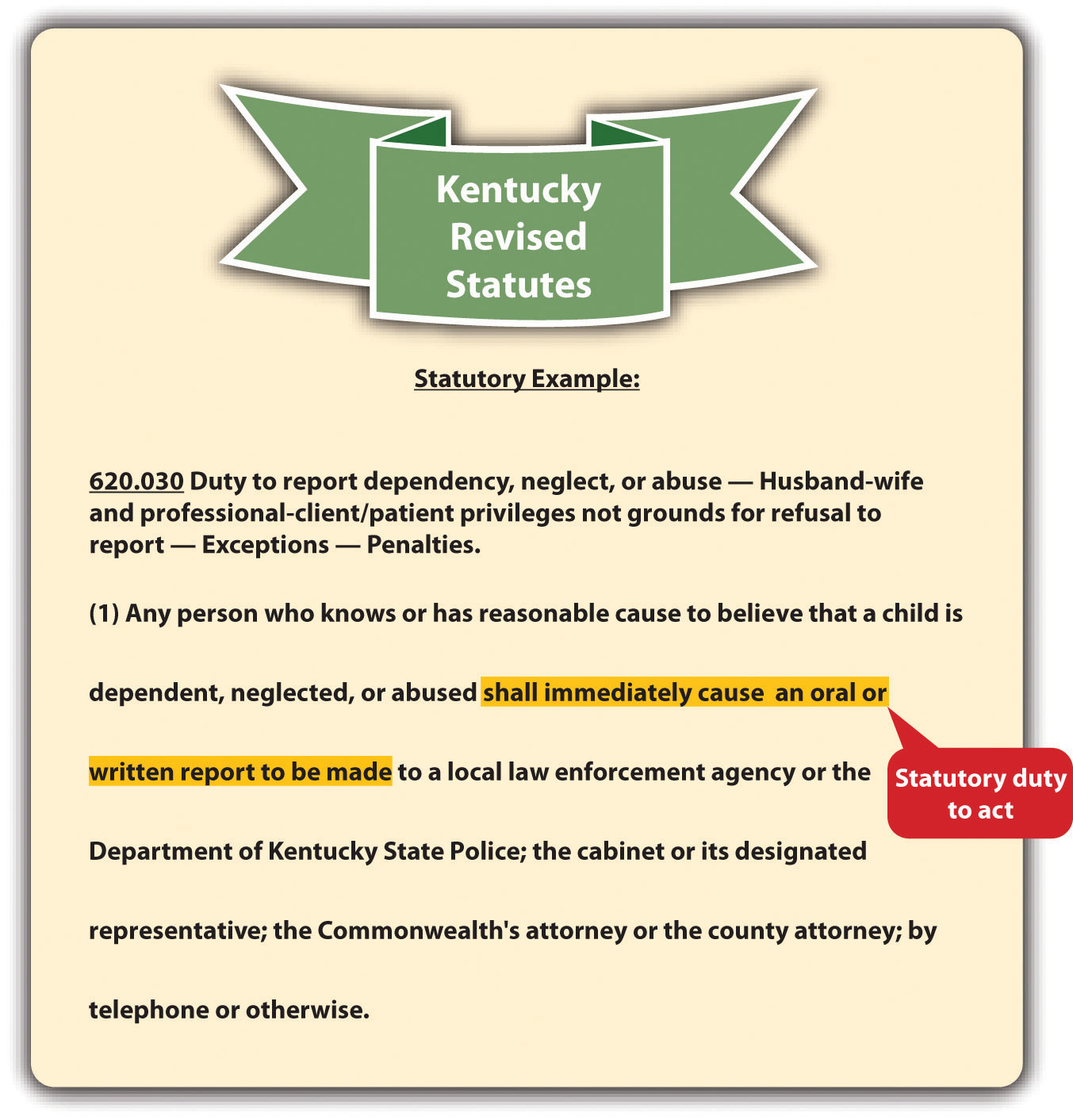
When a duty to act is statutory, it commonly concerns a regime involvement that is paramount. Some common examples of statutory duties to human activity are the duty to file state or federal taxation returns (26 U.S.C., 2010), the duty of wellness-care personnel to report gunshot wounds (Fla. Stat. Ann., 2010), and the duty to report child corruption (Ky. Rev. Stat. Ann., 2010).
Figure 4.3 Kentucky Revised Statutes
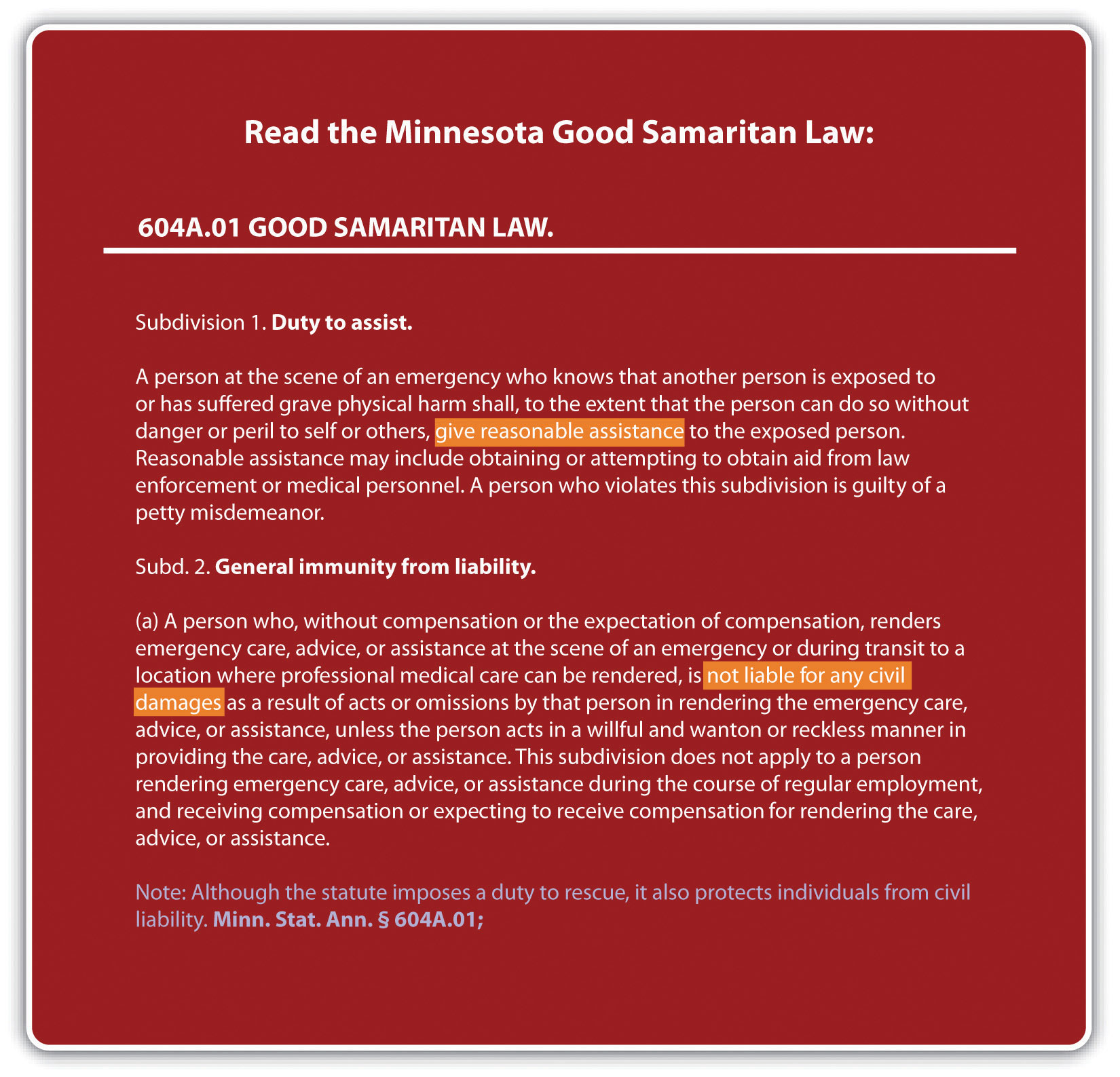
At common law, information technology was not criminal to stand past and refuse to assist someone in danger. Some states supersede the common law by enacting Good Samaritan statutes that create a duty to aid those involved in an accident or emergency situation. Practiced Samaritan statutes typically contain provisions that insulate the thespian from liability exposure when providing assistance (Minnesota Code, 2010).
Effigy 4.4 Minnesota Skillful Samaritan Law
Adept Samaritan Law Video
Expert Samaritan Sued subsequently Rescuing Adult female in an Accident
This video is a news story on a California Supreme Court case regarding the ceremonious liability of a Good Samaritan:
Duty to Act Based on a Contract
A duty to human action can exist based on a contract between the defendant and some other party. The most prevalent examples would be a physician's contractual duty to aid a patient or a lifeguard'south duty to save someone who is drowning. Keep in mind that experts who are not contractually bound can ignore an individual's pleas for help without committing a crime, no thing how morally abhorrent that may seem. For case, an adept swimmer can sentinel someone drown if there is no statute, contract, or special relationship that creates a legal duty to act.
Duty to Deed Based on a Special Relationship
A special relationship may besides be the footing of a legal duty to act. The most mutual special relationships are parent-kid, spouse-spouse, and employer-employee. Often, the rationale for creating a legal duty to act when people are in a special relationship is the dependence of one private on another. A parent has the obligation by law to provide food, article of clothing, shelter, and medical care for his or her children, because children are dependent on their parents and do not have the ability to procure these items themselves. In improver, if someone puts some other person in peril, in that location may be a duty to rescue that person (Land ex rel. Kuntz v. Thirteenth Jud. Dist., 2010). Although this is not exactly a special relationship, the victim may exist dependent on the person who created the dangerous situation considering he or she may exist the merely 1 present and able to render aid. On a related note, some jurisdictions as well impose a duty to proceed to provide aid, once aid or aid has started (Jones 5. U.S., 2010). Similar to the duty to rescue a victim the defendant has put in peril, the duty to continue to provide assist is rooted in the victim's dependence on the defendant and the unlikely take a chance that some other person may come along to help once the defendant has begun providing assistance.
Example of a Failure to Act That Is Noncriminal
Recall the instance from Affiliate 1 "Introduction to Criminal Law", Section 1.2.1 "Example of Criminal Law Issues", where Clara and Linda are shopping together and Clara stands past and watches as Linda shoplifts a bra. In this example, Clara does non have a duty to written report Linda for shoplifting. Clara does not have a contractual duty to report a crime in this situation because she is not a police force enforcement officeholder or security guard obligated by an employment contract. Nor does she have a special relationship with the shop mandating such a study. Unless a statute or ordinance exists to force individuals to report crimes committed in their presence, which is extremely unlikely, Clara can legally observe Linda's shoplifting without reporting it. Of course, if Clara assists Linda with the shoplifting, she has then performed a criminal act or actus reus, and a criminal prosecution is appropriate.
Example of a Failure to Act That Is Criminal
Penelope stands on the shore at a public beach and watches as a child drowns. If Penelope's state has a Good Samaritan constabulary, she may have a duty to aid the child based on a statute. If Penelope is the lifeguard, she may have a duty to salvage the kid based on a contract. If Penelope is the kid's mother, she may have a duty to provide assistance based on their special relationship. If Penelope threw the kid in the ocean, she may take a duty to rescue the child she put in peril. If Penelope is only a bystander, and no Good Samaritan law is in force, she has no duty to act and cannot exist criminally prosecuted if the kid suffers harm or drowns.
Possession as a Criminal Act
Although it is passive rather than active, possession is still considered a criminal act. The most common objects that are criminal to possess are illegal contraband, drugs, and weapons. At that place are ii types of possession: bodily possession and constructive possession. Bodily possession indicates that the defendant has the item on or very virtually his or her person. Effective possession indicates that the item is not on the defendant'south person, but is within the defendant'due south area of control, such equally inside a house or motorcar with the defendant (State 5. Davis, 2011). More than ane defendant can be in possession of an object, although this would clearly be a constructive possession for at least ane of them.
Considering information technology is passive, possession should exist knowing, meaning the accused is aware that he or she possesses the item (Connecticut Jury Instructions No. 2.xi-1, 2011). As the Model Penal Code states in § 2.01(iv), "[p]ossession is an human action, inside the meaning of this Section, if the owner knowingly procured or received the affair possessed or was aware of his control thereof for a sufficient period to take been able to finish his possession." In the vast majority of states, a statute permitting a conviction for possession without this knowledge or sensation lacks the criminal intent element and would exist unenforceable.
Example of an Unenforceable Possession Statute
A land has a criminal statute that prohibits "being within 100 anxiety of any quantity of marijuana." Ricardo sits next to Jean on the subway. A law enforcement officer smells marijuana and does a pat-down search of Jean. He discovers that Jean has a large baggie of marijuana in his jacket pocket and arrests Jean and Ricardo for marijuana possession. Ricardo was inside one hundred feet of marijuana every bit prohibited by the statute, but Ricardo should not be prosecuted for marijuana possession. No evidence exists to indicate that Ricardo knew Jean, or knew that Jean possessed marijuana. Thus Ricardo does non have the criminal intent or mens rea for possession, and the state'southward possession statute should not exist enforced confronting him.
Cardinal Takeaways
- The elements of a crime are criminal deed, criminal intent, concurrence, causation, harm, and attendant circumstances. Simply crimes that specify a bad result have the elements of causation and harm.
- Criminal act is ordinarily an unlawful bodily move that is defined in a statute, or a example in jurisdictions that permit mutual-law crimes.
- The criminal act must be voluntary and cannot be based solely on the condition of the defendant or the defendant's thoughts.
- An exception to the criminal human action element is omission to human activity.
- Omission to act could be criminal if there is a statute, contract, or special relationship that creates a legal duty to act in the defendant's situation.
- Actual possession means that the item is on or very near the defendant's person. Constructive possession means that the item is within the defendant'southward control, such every bit within a house or vehicle with the defendant.
- In nigh states, the accused must be aware that he or she possesses the item to be bedevilled of possession.
Exercises
Answer the following questions. Check your answers using the answer key at the end of the chapter.
- Jacqueline is diagnosed with epilepsy ii years after receiving her driver'southward license. While driving to a concert, Jacqueline suffers an epileptic seizure and crashes into some other vehicle, injuring both of its occupants. Can Jacqueline be convicted of a law-breaking in this situation? Why or why not?
- Read Oler v. Land, 998 S.W.2d 363 (1999). In Oler, the accused was convicted of possession of a controlled substance by misrepresentation. The defendant solicited and received prescriptions for Dilaudid, a controlled substance, from four different physicians without informing them that he already had a prescription for Dilaudid. The defendant appealed, arguing that he had no legal duty to disclose his previous receipt of the drug to the physicians, and was therefore unlawfully punished for an omission to act. Did the Texas Court of Appeals uphold the defendant'southward confidence? Why or why non? The instance is available at this link: http://scholar.google.com/scholar_case?case=460187562193844690&q= 998+S.W.second+363&hl=en&as_sdt=10000000000002.
- Read Staples v. U.S., 511 U.South. 600 (1994). In Staples, the defendant was convicted of possession of an unregistered automatic weapon in violation of the National Firearms Act. The defendant claimed the confidence was improper because the prosecution did not prove that he knew the weapon was automated, and the prosecution must testify this knowledge to captive under the statute. Did the United states of america Supreme Court reverse the defendant's confidence? Why or why not? The case is available at this link: http://world wide web.law.cornell.edu/supct/html/92-1441.ZO.html.
References
Connecticut Jury Instructions No. 2.11-ane, accessed Feb xiii, 2011, http://www.jud.ct.gov/ji/criminal/part2/2.eleven-1.htm.
Fla. Stat. Ann. § 790.24, accessed October 25, 2010, http://law.onecle.com/florida/crimes/790.24.html.
Govt. of Virgin Islands v. Smith, 278 F.2nd 169 (1960), accessed October 26, 2010, http://openjurist.org/278/f2d/169/authorities-of-the-virgin-islands-v-smith.
Jones v. U.S., 308 F.2d 307 (1962), accessed October 25, 2010, http://scholar.google.com/scholar_case?case=14703438613582917232&hl=en&as_sdt=2002&as_vis=one.
Ky. Rev. Stat. Ann. § 620.030, accessed Oct 25, 2010, http://world wide web.lrc.ky.gov/krs/620-00/030.pdf.
Minnesota Code § 604A.01, accessed Oct 25, 2010, http://law.justia.com/minnesota/codes/2005/595/604a-s01.html.
N.Y. Penal Police § xv.00, accessed October 25, 2010, http://law.onecle.com/new-york/penal/PEN015.00_15.00.html.
State ex rel. Kuntz v. Thirteenth Jud. Dist., 995 P.2nd 951 (2000), accessed October 25, 2010, http://caselaw.findlaw.com/mt-supreme-courtroom/1434948.html.
Country five. Davis, 84 Conn. App. 505 (2004), accessed February 13, 2011, http://scholar.google.com/scholar_case?case=12496216636522596448&hl=en&as_sdt=2&as_vis=1&oi=scholarr.
26 UsaC. § 7203, accessed October 25, 2010, http://www.law.cornell.edu/uscode/26/usc_sec_26_00007203—-000-.html.
Source: https://open.lib.umn.edu/criminallaw/chapter/4-1-criminal-elements/
0 Response to "what are the elements that must be present for a crime to have occurred"
Enviar um comentário